How I would make your website AI native in 2027, before your competition does
Most websites hand an AI agent a phone number and a contact form, and to an agent that's a locked door.
The story
This is probably going to be hard to hear, but your website won't matter in five years, at least not the way it works today. The folks who never bothered to put one up are probably celebrating, but they're going to struggle for new business too. We are moving to an AI-native world, and most websites are simply not prepared for it. Mine wasn't either. Now it is.
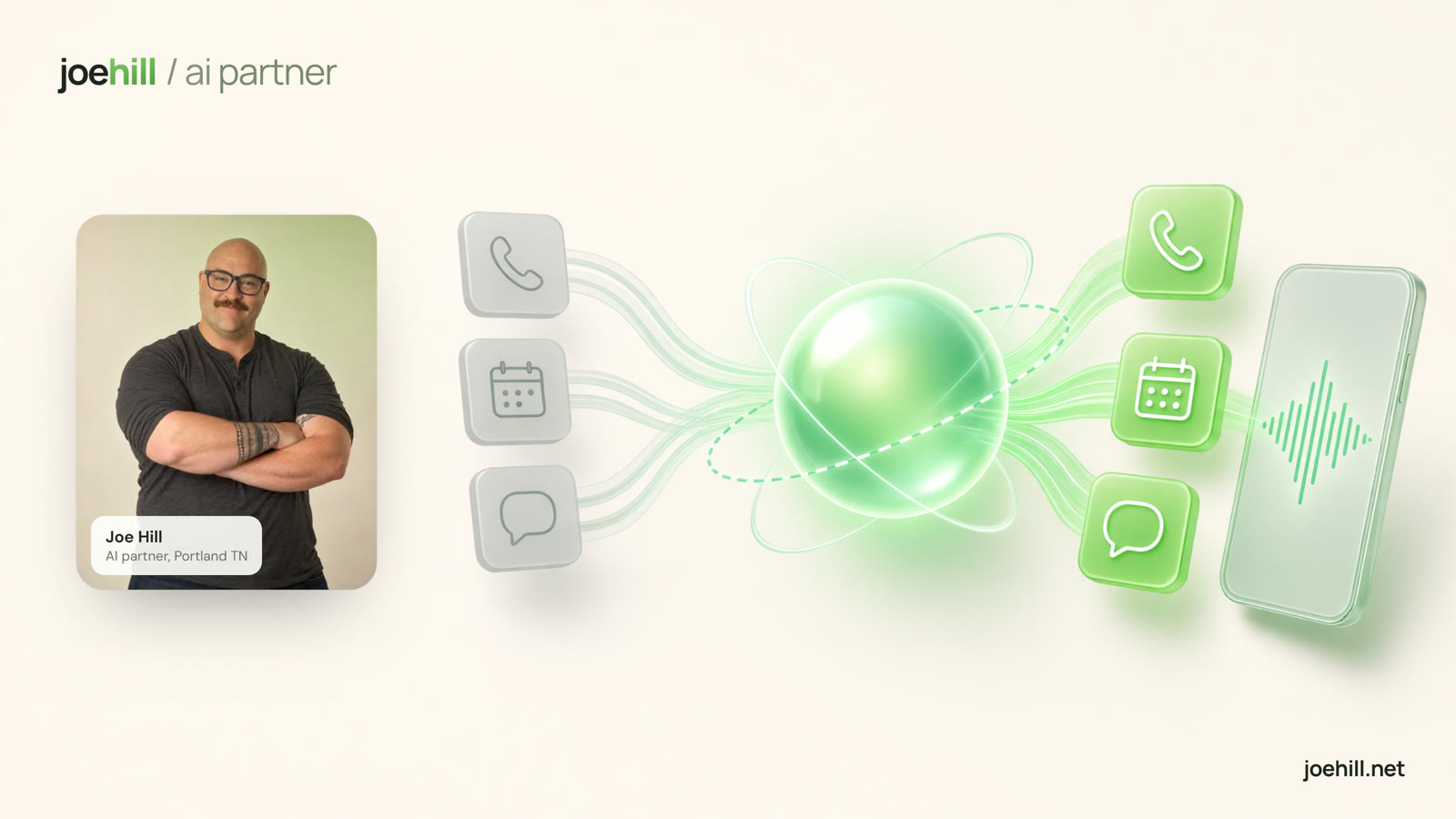
The Work with me panel at the bottom left of every page is a simple booking form an AI agent in a browser can fill in, and every page offers WebMCP tools to that agent (see my open times, book a call, ask Harvey). An agent in a chat window, Claude, ChatGPT or any other MCP client, can add mcp.joehill.net as a connector and book directly. And if a person lands here (welcome, by the way, and thanks for clicking through) they can talk to my AI assistant Harvey by text or voice right on this page: the phone icon at the bottom right on a phone, the voice button in the bar on a desktop.
My best friend called me yesterday with a gas leak. All at once he needed a plumber, and he called every plumber in town before one picked up, with the gas company still to deal with on top of it. (If that's ever you, leave the house and call the gas company before anything else. The plumber is the part that can wait a few minutes.)
Now imagine the same afternoon a year or two from now. He tells whatever assistant is on his phone: get me a licensed plumber here as soon as possible, I have to go deal with the gas company. The assistant goes looking, and most plumbers' websites hand it a phone number and a contact form, which to an agent is a locked door. Yours has your facts in a form it can read, a booking form it can fill in from a browser, and a door it can book through directly. By the time he hangs up with the gas company there's a notification waiting: no problem, I booked the plumber, he's on his way. Swap the plumber for any business that takes bookings or inquiries and nothing changes. The next customer may never look at your website. Their agent will.
An AI assistant on its own won't keep your website from going obsolete next year. Not being AI friendly definitely will.
What I'd put on your site
Three front doors on one site, all reading the same facts and the same calendar. For an agent driving a browser, a plain booking form on every page with nothing to puzzle out: your open times, the fields you need, a confirmation it can read back to its person. For an agent in a chat window, an MCP door on the back end, so it can ask what you do and book without loading a page. For a person, an assistant like Harvey, by text or voice, right on the page. Behind all three, your facts written once in a form a person and a machine both read, your real calendar, and a log of everything that came through each door.
The rules it follows
- Your facts are written once, in plain words, and a person and an agent read the same thing: what you do, where, for whom, your license, your hours.
- An agent can book without a trick: the fields you need, your open times, a confirmation it can read back. Anything a person can do on your booking form, an agent can too.
- Every door reads one calendar, so a booking from an agent, a chat and a call can never land on the same slot.
- An agent can ask questions and book time. Anything that touches money or changes a job waits for your yes.
- The assistant says it's an AI when asked, never quotes a price and never pretends to be you. Every visit through every door is logged.
The log is how you find out what's actually arriving: how many agents, how many people, what they asked for and where they gave up. Read it yourself the first month, and what they asked for is the next thing you write down.
How you'd build this yourself
Four steps, and none of them needs a particular product. You need a booking tool with an API that knows when you're free, a place to run a small piece of code, and an afternoon to write down your facts.
- Write your facts for machines tooPut what you do, where, for whom, your license and your hours in one place, in plain words. Publish the same facts in the forms agents read: a plain-text summary at a known address (llms.txt is the convention) and structured data on the page. Keep one source for both so they never disagree, and when something changes, change it there.
- Make booking work without a personConnect a booking tool that knows when you're free, with notice, buffers and a daily cap. Then put a booking form on every page that an agent driving a browser can finish: plain labels, the fields you need and no more, and a confirmation that states the time, the place and who's coming.
- Open a door for chat agentsPut an MCP server in front of the same booking tool and the same facts, so an agent in a chat window can ask what you do, see open times and book, with no page load at all. Give it the booking tools and your facts and nothing else: no customer data, no payments, no way to change a job that already exists.
- Give people an assistant, and log every doorFor the humans, an assistant on the page by text or voice that answers from the facts you wrote, books from the same calendar, hands off to you when someone wants you, and says it's an AI when asked. Keep every chat, call and agent booking in one log and read it the first month: what agents asked for, where they gave up, and what turned into a booked job.
Let's get your site ready for the agents.
If you'd rather not build it, that's what I do: the facts, the booking an agent can finish, the MCP door, the assistant and the log, all running in your own accounts. Try the human door first if you like. Harvey is at the bottom of this page, by text or voice.
Keep reading
An amazing digital staging process sets an agent apart
Staging costs real money, so a lot of listings go up empty.
The first thing I check in any business (you can check it yourself right now)
Fix anything but the constraint and almost nothing changes.
An owner let AI clean up the books. The bookkeeper got a bigger mess.
Bookkeepers are fixing a bigger mess after AI 'clean-ups' of QuickBooks.